
DICM Steering Group: Governance, Legal & Procedural Alignment Framework
The Dual Impact Collaboration Model (DICM) Steering Group is the independent, executive governing body responsible for ensuring that the DICM Engine and its algorithmic matching protocols operate in strict compliance with public procurement regulations, national legislation, and global auditing standards.
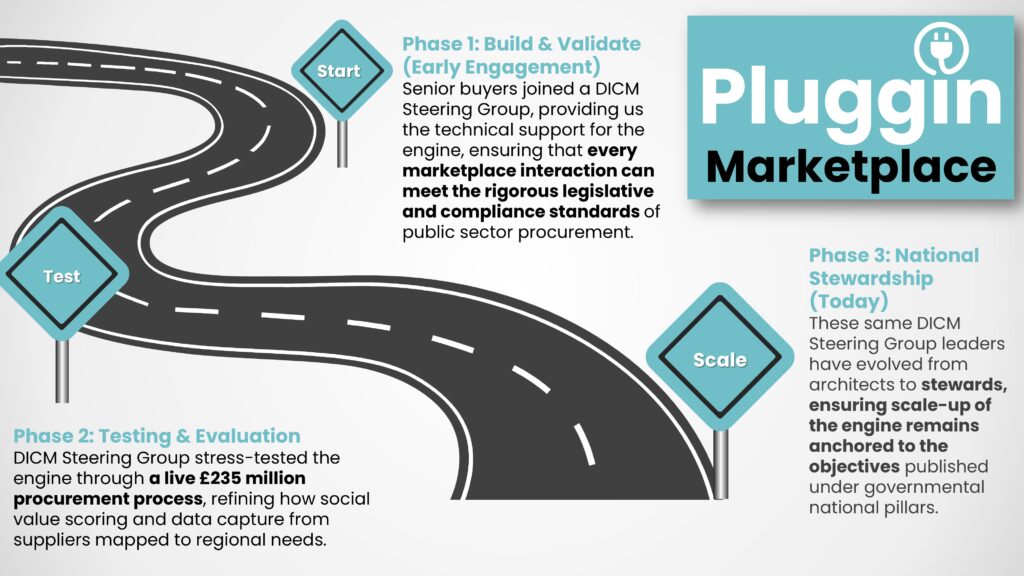
Established by Pluggin’s executive leadership, the Steering Group was built in active, ground-up collaboration with senior policing leaders and Crown procurement authorities. By co-designing the platform's compliance and delivery guardrails with the very authorities responsible for public spending and regional safety, we have ensured that the socio-economic benefits returned to public authorities are legally robust, contractually bound, and completely uncontestable.
The Founding Coalition & Regional Alignments
The structural integrity of this framework was designed, refined, and deployed in collaboration with a founding coalition of public sector procurement pioneers who aligned the DICM Engine directly with UK policing and crown commercial frameworks.
|
Steering Group Rep |
Public Sector Authority / Agency |
Strategic Alignment & Regional Mandate |
|---|---|---|
|
Richard Fowles |
Thames Valley Police |
First-Force Co-Creator: Supported the initial DICM Engine forces integration; helped align contract social value with PCC youth violence, exploitation, and safety objectives. |
|
Jonathan Strelitz |
West Mercia Police |
West Midlands Lead: Joined Fowles to structured a £235M social value pilot; and led the standardisation of cross-regional procurement protocols and Home Office links to target community health, safety and resilience. |
|
Dave Levy |
Seven Force Commercial |
Multi-Force Infrastructure: Chartered commercial advisory expert aligning collective public buying frameworks across the East of England. |
|
Sian Freeman |
South Wales Police & Gwent Police |
Welsh Legislative Lead: Operationalised alignment with the Welsh Government network. |
|
Stuart Jose |
South West Police Forces |
South West Lead: Structure localised matching protocols to target regional safety, rural vulnerability, and supply chain integrity. |
|
Toni Fairchild-Burke |
GCA (Government Commercial Function) |
Crown & Central Alignment: Bridged central government commercial practices with regional public sector procurement structures. |
|
Alison Jerred MCIPS |
Thames Valley Police & Hampshire & Isle of Wight |
South East Delivery Lead: Led the practical buyer onboarding process development, tender scoring and alignment to Bluelight Commercial (framework) requirements. |
Core Infrastructure: The Trinity of Social Equity
The Steering Group exists to govern the buyer use of the three structural pillars of the Pluggin Ecosystem:
-
The Pluggin Marketplace: The disruptive commercial arena where public buyers contract social value, and Tier-1 suppliers compete for brand superiority across regions based on verified performance.
-
The Dual Impact Collaboration Model (DICM) Engine: The underlying matching technology that programmatically locks S.M.A.R.T social value directly into active, live contracts. This eliminates supplier "give-away" discretion and retroactively binds the commitment to contract performance.
-
The Research Hub: The analytical brain that collects real-time charity beneficiary outputs at specific contract reference levels and correlates them against public authorities' own localised safety, health, and crime statistics.
Statutory and Legislative Alignment
The DICM Engine translates legislative mandates into programmatic, contract-level execution. The Steering Group can continuously audit the Engine’s matching matrices to ensure compliance with key regulatory frameworks.
The Legislative Mapping Matrix
|
Statute / Regulation |
Legacy Compliance Gap |
The DICM Engine Programmatic Solution |
|---|---|---|
|
Public Services (Social Value) Act 2012 |
Subjective, unweighted tender promises; unverified "intent" with zero post-award contract reconciliation. |
Algorithmic binding of tender scored commitments to live, media-evidenced delivery chains, creating a legally enforceable audit trail. |
|
Procurement Act 2023 |
Opaque supply chains; lack of contract performance transparency; weak KPI reporting enforcement. |
Automatic integration of S.M.A.R.T contractual KPIs into the public register; real-time performance tracking with direct linkage to the contract ID. |
|
National Pillars & Local Plan Objectives |
Short-term, isolated community interventions failing to map to the core Goals. |
Direct mapping of localised grassroots outputs to local, regional and national public authority statistical baselines (preventative health, safety, and economic resilience). |
|
HM Treasury Green Book & Procurement Policy Note (PPN) 06/20 |
Qualitative narratives disconnected from quantifiable, localised socio-economic impacts. |
Quantitative, geographically targeted resource allocation based on real-time crime and safety indices at the specific contract location. |
Regional Strategic Framework Alignment
The Steering Group exists to enforce distinct, localised programmatic scoring and matching matrices to align with the statutory plans of regional public authorities.
England
For contracts executed within English authorities, the DICM Engine maps and delivers social value assets directly against the strategic priorities of Home Office and Local Police and Crime Plans:
-
Tackling Crime & Harm: Disrupting county lines, reducing anti-social behavior (ASB), and preventing youth violence.
-
Victim-Centric Care: Channeling operational resources to localized grassroots organizations supporting victims of trauma and exploitation.
-
Visible & Effective Policing: Creating community resilience hubs to decrease the resource burden on frontline officers.
-
Violence Against Women and Girls (VAWG): Allocating resources to prevention programs, safe spaces, and educational workshops.
-
System Efficiency & Ethics: Ensuring total transparency and auditability of public contract social value.
Wales
For contracts executed within Wales, the DICM Engine maps resources to the statutory obligations of the Well-being of Future Generations (Wales) Act 2015:
-
Foundational Economy & Fair Work: Targeting resource supply chains into hyper-local micro-enterprises and community cooperatives.
-
Health, Wellbeing & Social Equity: Tackling root-cause health inequalities through grassroots preventative intervention.
-
Cohesive Communities & Localism: Reinvesting contract-derived economic benefits back into the precise geographic location of the contract delivery.
-
VAWDASV (Violence Against Women, Domestic Abuse and Sexual Violence): Focusing on primary prevention, community-led safety networks, and educational support.
The Full-Circle Chain: Legal Auditability
To satisfy the requirements of central government departments (including the Cabinet Office, Home Office, and Ministry of Justice), the Steering Group is supporting the unbreakable evidence chain.
This mathematical and logical sequence ensures that every pound of contractually bound social value resource is tracked from tender to statistical prevention output.
The DICM Engine programmatically enforces and logs this progression:
-
Contract X-Reference: The unique identifier generated by the public buyer's e-procurement system.
-
Tender Scored Commitment: The S.M.A.R.T social value proposals pledged by the winning supplier during the bidding phase.
-
Live Contract ID: The active, legally binding contract SLA under which pledged resources are deployed.
-
Media-Evidenced Activity: Geotagged, timestamped, and media-verified delivery updates of social value from pre-vetted grassroots partners on the ground.
-
Statistical Prevention Output: The measurable reduction in localised risk metrics (e.g., youth crime, reoffending, health inequalities) mapped directly back to the contracting authority’s strategic goals and contracts.
Accessing Social Value Data: The Closed DICM Engine
To guarantee total data security, integrity, and compliance, Pluggin operates a closed (community-managed) environment and does not utilise open APIs or external public-facing database links.
-
The Dashboard: Public buyers and authorised government auditing agencies access Pluggin for live performance metrics, regional risk maps, and contract-level transaction data exclusively through a secure, closed-loop dashboard within the DICM Engine environment.
-
Integrated AI Agent Interrogation: Rather than manually scanning complex data logs, authorised users utilise "Plug" the secure DICM AI Agent built to query, cross-examine, and report on active contract delivery streams inside the Pluggin real-time infrastructure. This allows commissioners and agencies to instantly verify that the unbreakable evidence chain has been maintained for any given contract reference, generating exportable compliance reports on demand.
Operational Comparison: Legacy vs. The Pluggin Standard
The Steering Group focuses upon a strict operational division between Tier 1 supplier legacy "corporate social responsibility promises" and regulated, contractually bound delivery collaborations executed by the DICM Engine.
|
Operational Dimension |
Legacy Corporate Gifting |
The Pluggin Governed Standard |
|---|---|---|
|
Legal Binding |
Discretionary "give-away" or marketing budget; easily cancelled during economic downturns. |
Contractually bound operational resource; non-delivery constitutes a material breach of contract. |
|
Resource Allocation |
Determined by corporate PR teams; disconnected from local public authority strategic priorities. |
Programmatically matched by the DICM Engine to address real-time, localised risk and safety statistics. |
|
Verification Method |
Annual self-reported sustainability PDF booklets containing unverified anecdotes. |
Real-time, media-evidenced activity streams verified independently via the Pluggin Research Hub. |
|
Impact Measurement |
Input-focused metrics (e.g., "amount of money spent" or "hours of volunteering promised"). |
Outcome-focused prevention outputs correlated with objective, regional government statistical indices. |
|
Regulatory Standing |
Vulnerable to procurement challenges due to lack of transparency and objective criteria. |
Fully aligned with PPN 06/20 and the Procurement Act 2023 transparent scoring and delivery metrics. |